Higher Diploma in Theological Studies (Blended Learning)
This one-year, evening/weekend, Level 8, 60 ECTS credits programme gives a foundation in Theological Studies to students who hold a primary degree in another discipline. This Higher Diploma meets all the Teaching Council of Ireland’s Requirements for the teaching of Religious Studies at post-primary level. It entitles teachers holding Department-recognised degrees and teacher training qualifications to teach up to 15 hours’ Religious Education per week in a secondary school.
Professional Programmes - Part Time |
1 Year |
| Fees and Funding | |
Application Deadline: |
15th August 2024
For EU & those living on the island of Ireland (Late applications may be considered). |
|
31st May 2024
For non EU |
|
Course Start Date: |
September 2024 |
| Get info | Apply now |
Introduction
This one-year, evening/weekend, Level 8, 60 ECTS credits programme gives a foundation in Theological Studies to students who hold a primary degree in another discipline. This Higher Diploma meets all the Teaching Council of Ireland’s Requirements for the teaching of Religious Studies at post-primary level. It entitles teachers holding Department-recognised degrees and teacher training qualifications to teach up to 15 hours’ Religious Education per week in a secondary school.
Description
The Higher Diploma in Theological Studies from St. Patrick’s Pontifical University attests to the completion of a substantial and coherent programme of learning. The Higher Diploma allows students to finish an accredited introductory programme in theology and to obtain a credential for it. Other students who achieve a Second Class Honours Grade I, or better, may use the programme as a gateway to applying to a Master’s programme in Theology or Pastoral Ministry either in Maynooth or elsewhere (students interested in entering a Master’s programme are advised to speak with the Admissions Office prior to starting the HDip for further details).
Others may be interested in the programme simply as a structured way to approach the big questions in life, giving their personal inquiry a theological shape in the Catholic tradition. Additionally, the Higher Diploma equips graduates to take a more active role in their local church community.
Higher Diploma in Theological Studies (Blended Learning) - Some information from the Programme Director and Past Students
ASSESSMENT
All core courses will be assessed by means of either coursework or end of semester examination.
Accommodation
ACCOMMODATION
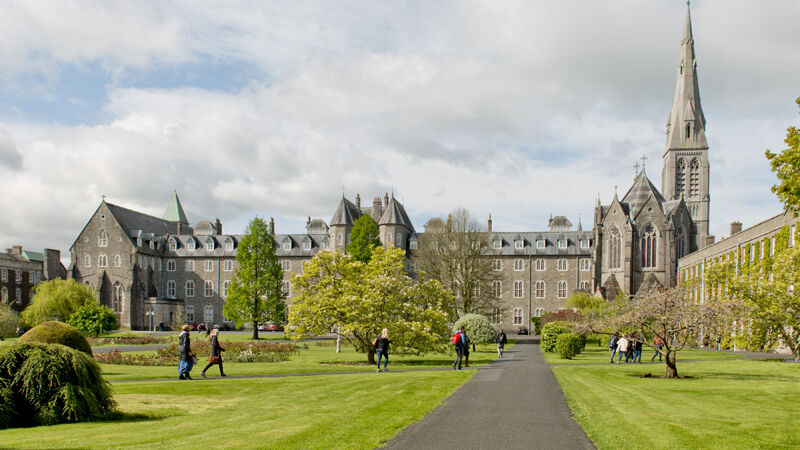
Overnight facilities are available in the College at a discounted rate. While students need only stay in the area on Friday nights, they are welcome to either stay on either Thursday night or Saturday night at a discounted rate to conduct research or simply enjoy some free time on the historic college campus.
Rates and information from the Maynooth Campus Conference and Accommodation Office. Students must produce student card. Early booking is advisable.
Telephone: 01-708-6400 Fax: 01-708-3534
E-mail: Reservations@Maynoothcampus.com
Web Page: www.Maynoothcampus.com
Please phone the Conference Centre directly to avail yourself of the special rates.
Please note that if social distancing rules make it impossible to gather on campus for any of the weekend residentials, the programme will still go ahead with the residentials in question being held on-line.
Fees
Please see our Fees Listings for more details
Instalment option
Students may spread their fees over four payments as listed below.
September - 1037.50
November 30th - 887.50
January 31st - 887.50
April 30th - 887.50
For further information, contact our team at fees@spcm.ie
Timetable
TIMETABLE
Students are expected to be available on every Wednesday evening during term time from 6.30 p.m. – 9.30 p.m. On Wednesday evenings content will be delivered “live” on an on-line teaching platform. Students can participate from home.
Another 3 hours of self-directed learning will be provided for each week in term time, that can be done whenever in the week it suits the students.
Please note that students will be expected to devote additional time to study and working on assignments every week.
6 weekend residentials (Friday/Saturday), three each term. This is when the face to face classes will take place and when students have a chance to meet their lecturers and each other. Additionally, it is a good time to take advantage of the many resources that the historic campus offers (and the amenities of Ireland’s only university town). Students are not obliged to stay on campus but as part of the programme you can avail of the very competitive discounted room rates provided by the Conference and Accommodations’ Office.
The following is the weekend timetable:
Friday
Arrival/check in: 6:00pm-6:30pm;
coffee break 6:30-6:55 pm;
class: 7:00pm-9:00pm;
Saturday
Breakfast: 8:00am,
class: 9:00am-11:00am;
class: 11:00am-1:00pm;
lunch: 1:00pm-2:00pm;
class or library time: 2:00pm-3:00pm;
class 3:00pm-5:00pm.
Course Content:
A general introduction to theology, giving students the necessary foundations for an academic treatment of theology in accordance with St. Anselm’s maxim of “faith seeking understanding.”
- Sacred Scripture, which studies the Bible – its nature and significance, origins, literary forms, interpretation today. It will include a study of particular Old Testament and New Testament books.
- The History of Christianity including its origins and contemporary experience.
- World Religions, including the major world religions and their relationship to Christianity. Human dignity and religious freedom are also included in the course.
- Secular belief systems and how Christianity engages with their challenges and legitimate questions.
- Moral Theology, which deals with the experience of morality and in particular with the bearing of Christian faith on the moral life. Topics include: conscience, making moral decisions, the Bible and morality, bioethics, justice, morality and law, ethics in public life, peace and war and ecology.
- Systematic Theology, which studies the meaning and implications of the principal faith-affirmations of Christianity concerning God, Jesus, the Church, the human condition.
- Foundations of Worship, which provide the student with critical skills in exploring the nature and history of Christian Liturgy
- Foundations in Religious Education, which provides students with an introduction to the meaning, tradition and contemporary practice of religious education with a particular focus both on the teaching of Religious Education at post-primary level, with particular but not exclusive reference to Catholic Education
- The Philosophy of Religion which studies the philosophical debate concerning the existence and nature of God. It also considers the interplay between reason, science and religion.
Career Outcomes
The Higher Diploma in Theological Studies meets all the Teaching Council of Ireland’s Requirements for the teaching of Religious Studies at post-primary level. It entitles teachers holding Department-recognised degrees and teacher training qualifications to teach up to 15 hours’ Religious Education per week in a secondary school. Other graduates may use the programme as a gateway to applying to a Master’s programme in Theology or Pastoral Ministry either here in Maynooth or elsewhere (students interested in entering a Master’s programme are advised to speak with the Admissions Office prior to starting the HDip for further details). Others may be interested in the programme simply as a structured way to approach the big questions in life, giving their personal inquiry a theological shape in the Catholic tradition. Additionally, the Higher Diploma equips graduates to take a more active role in their local church community.
Course Structure
Application Requirements
Applications are now being accepted on www.pac.ie (Code - MU518)
If you have any queries please contact admissions@spcm.ie.
Normal entry requirements:
- A primary degree or its equivalent is required. While the degree/qualification will normally be in a discipline other than Theology, consideration will be given to all applications.
- University issued or certified copies of official transcripts of results for qualifications must be included with the application. These copies are kept by the University. Copies can be certified/stamped by the relevant institution or by a member of an Gárda Siochána, as a true copy of the original: Members of the police, a Medical doctor, A member of the clergy, a Lawyer/Solicitor, a School principal/vice principal. Just as long as they’re not related to the applicant.
- All credentials in languages other than English must be accompanied by certified English translations;
- Applicants whose first language is not English will be required to satisfy the English language requirements. See here for more information: https://sppu.ie/english-language-requirements;
- Students must provide a digital passport style photograph that will be used in the College’s computer system to identify the student to lecturers and other students;
- As this course is delivered in a hybrid manner with much of the content being given on-line, students are required to have basic academic computer skills and have access to a computer and the internet.
Further information:
Admissions Office,
Pontifical University,
St Patrick’s College,
Maynooth,
Co. Kildare.
Telephone: 01-708 3391
Fax: 01-708 3441
E-mail: pgadmissions@spcm.ie
Web site: www.sppu.ie
Course Director:
Prof. Séamus O'Connell
St. Patrick’s College
Maynooth
Co. Kildare,
e-mail: seamus.oconnell@spcm.ie
Selection procedure
First-come, first-served basis (provided entry requirements have been met and application is complete and correct).
Closing date for receipt of completed application forms for the September 2024 intake is 15 August, 2024.
However late applications will be considered. Please contact Admissions Office.
If you live outside Ireland, check out our dedicated area for international students.
Let’s talk
For Undergraduate queries: email admissions@spcm.ie.
For Postgraduate queries: email pgadmissions@spcm.ie.
For The Centre for Mission & Ministries queries, email: cmmadmissions@spcm.ie.